

Sustainability Policy

- Basic Approach to Sustainability
- Risk Management Structure
- Internal Structure for Sustainability Management
- Sustainability governance
- Material Issues (Materialities)
Basic Approach to Sustainability
For a general trading company dealing in machinery and technology that aims to sustainably grow its business and create new industrial value, contributing to the realization of a sustainable society means aiming to be a company that creates future value for industry. With the aim of a sustainability economy and the creation of social value, we have designated the promotion of sustainability management as a priority measure and has formulated various policies (in the areas of the environment, quality and product safety, occupational safety and health, human capital, human rights, and procurement policies), and through business activities based on these policies, we aim to achieve social value in order to contribute to the sound development of society.
Basic Sustainability Policy
Based on our Corporate Motto, “Our motto is to contribute to society through our business activities,” we, as a group of professionals in machinery and technology, will continue to innovate and evolve in order to provide value to society and contribute to the creation of future value for industry. In addition, we aim to be a company that is trusted by its stakeholders by actively working to resolve the issues faced by society, including environmental issues, toward the realization of a sustainable society. At the same time, we will build a transparent management system and actively disclose information to achieve this goal.
Internal Structure for Sustainability Management
In order to promote management based on the perspective of sustainability, we have established a Sustainability Promotion Committee chaired by the director overseeing administration. The Sustainability Promotion Committee discusses topics to be addressed by all companies over the medium-to-long term—such as targets related to material issues (materialities) for sustainability, including matters relating to climate change—and the direction in which to proceed, and sets policies and targets for all companies. The committee also builds and establishes the structure to put these things into action and monitors the status of initiatives. In this structure, the main issues compiled by the Sustainability Promotion Committee first pass through the Board of Corporate Management and are then reported and proposed to the Board of Directors, before supervision is enacted and direction provided.
Sustainability Promotion Organization Chart

Sustainability governance
Tsubakimoto’s Board of Directors sees action on sustainability issues as a material issue in terms of management and places it at the core of medium- to long-term management strategy. In order to deal with sustainability issues, we have established a Sustainability Promotion Committee as an advisory body for the Board of Corporate Management, which is chaired by the Representative Director & President. The Sustainability Promotion Committee is chaired by the director overseeing the administration and comprises three or more committee members nominated by the Board of Corporate Management. It works toward sustainable corporate growth and corporate value creation over the medium to long term by undertaking management from the perspective of sustainability and aims to ensure the Company lives up to the trust placed in it by its stakeholders.
The Board of Directors receives reports and recommendations on the Sustainability Promotion Committee’s conclusion through the Board of Corporate Management, reviews and deliberates on risks and opportunities as necessary, and provides approval, supervision and direction to the Sustainability Promotion Committee on the basis of the results.
The Sustainability Promotion Committee meets at least once a year and regularly reports to the Board of Directors on the content of its meetings. In addition, the Sustainability Promotion Committee works to ensure reliability in the implementation of improvement measures by managing the status of initiatives on management issues to be tackled in line with instructions from the Board of Directors. The Sustainability Promotion Committee has a Secretariat. The role of the Secretariat is fulfilled by Sustainability Promotion Execution Teams, which perform the procedures for convening the Sustainability Promotion Committee in accordance with instructions from the chairperson while also taking responsibility for administration and the creation of minutes.
Material Issues (Materialities)
We aim to contribute to the resolution of issues faced by society and to the building of a sustainable society through its business activities, and based on the Basic Sustainability Policy of the Group, we identify materialities (material issues) in management. We also implement progress management on the basis of KPIs defined to evaluate initiatives in terms of these materialities.
In addition, to further deepen our awareness of our social responsibility and achieve increasing corporate value over the medium-to-long term, we are working to strengthen our sustainability initiatives.
Furthermore, by identifying changes in the business environment and implementing the materiality identification process on a regular and ongoing basis, we are able to perceive changes in importance and reflect them in our business activities.
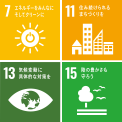
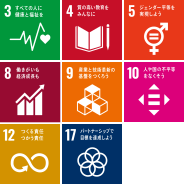
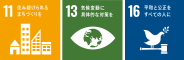
| ESG | Changes in External Environment | Material Issues | SDGs |
|---|---|---|---|
| Environment |
|
|
 |
| Social |
|
|
 |
| Governance |
|
|
 |
KPI (Key Performance Indicators)
| Materialities | KPI | FY2022 (actual) |
FY2023 (actual) |
FY2024 (actual) |
FY2025 (actual) |
FY2030 (actual) |
|
|---|---|---|---|---|---|---|---|
| E | Action to achieve a decarbonized society | GHG emissions (Scopes 1 and 2)*1 | 28% reduction | 27% reduction | 26% reduction | 30% reduction | 50% reduction*2 |
| S | Strengthening human capital measures | Ratio of females in career track positions | 4.8% | 6.0% | 5.4% | 8.0% | 10.0% |
| Ratio of male employees taking childcare leave | 82.0% | 70.0% | 84.0% | 100.0% | 100.0% | ||
| Employee engagement*3 | - | 100 | 107 | 115 | 125 | ||
| Action to achieve an automated society | Persons with specific qualifications*3*4 | 100 | 101 | 104 | 115 | 120 | |
| Strategy for high added value | Human added value ratio*3 | 100 | 106 | 108 | 108 | 110 | |
| Strengthen overseas business | Ratio of overseas sales in net sales | 14.7% | 11.6% | 12.5% | 16.0% | 20.0% | |
| Strengthen digital-related fields | Net sales in digital-related fields | 8.7 billion yen | 9.8 billion yen | 10.8 billion yen | 10.5 billion yen | 13.0 billion yen | |
| Improve productivity by investing in DX | Paper document volume (paperless)*5 | - | - | 30% reduction | 50% reduction | 70% reduction | |
| G | Promote sound business activities with an emphasis on sustainability management | Supplier questionnaire response rate | - | - | 70% | 80% | 100% |
| Safety confirmation drill message response rate | 70% | 85% | 96% | 100% | 100% | ||
| Ratio of companies with a companywide BCP in place | - | - | 41% | 56% | 100% | ||
| No. of serious compliance violations | 0 | 0 | 0 | 0 | 0 |
- *1 Vs. fiscal 2013 (1,293 t-CO2)
- *2 Carbon neutral by 2050
- *3 index
- *4 managing engineers
- *5 Vs. fiscal 2023 (Osaka and Tokyo Head Offices)
Total support for on-site issues with
100 years of experience in corporate technology.